
Radio 270
Sales
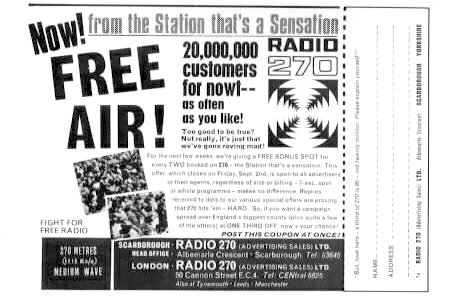
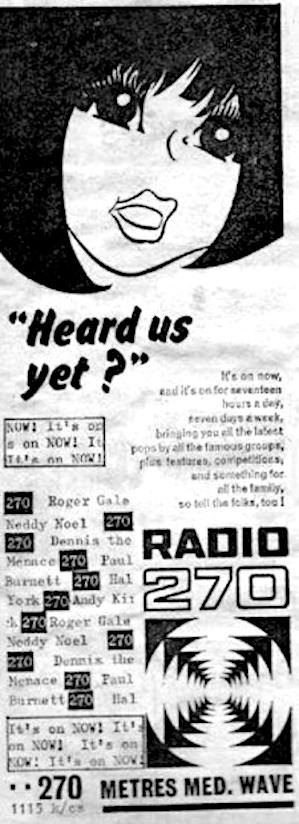
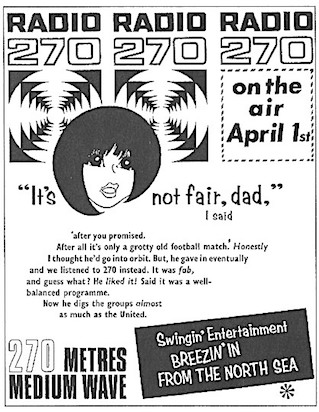
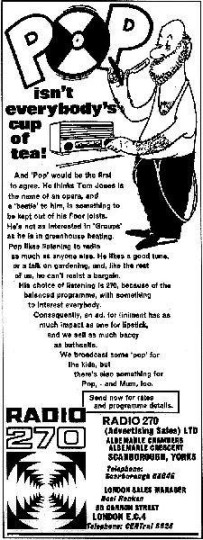
Radio 270''s delay until June 1966, followed immediately by the tragedy surrounding Radio City, meant that national sales were not very quick in coming. Radio Caroline had increased power to compete with Radio London, plus the twin Swinging Radio England and Britain Radio operations swallowed up what 'big bucks' advertising there was.
By Autumn 1966, the Radio 270 board had decided to take Wilf Proudfoot's advice and focus on local advertising. Deals were cut with local and regional companies, such as Skopes Trousers of Leeds, Coupland Bakeries of Scarborough and others.
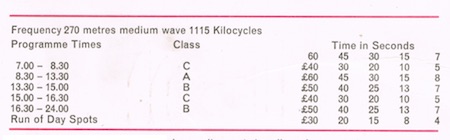
The station also emphasised its local appeal, and attracted several hundred local 'one man' businesses to advertise by haveing a seperate Rate Card for local advertisers. These included Stardisc of Hull, and dozens of small estate agents, lawyers and even hairdressing salons, who suddenly could afford to be "on the radio". Almost all got a huge response.
Radio 270
Free Petrol
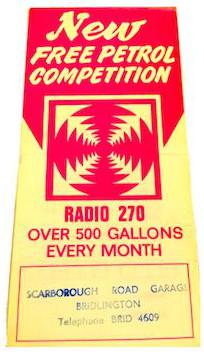
One of the most successful promotions was for the Radio 270 Free Petrol scheme.
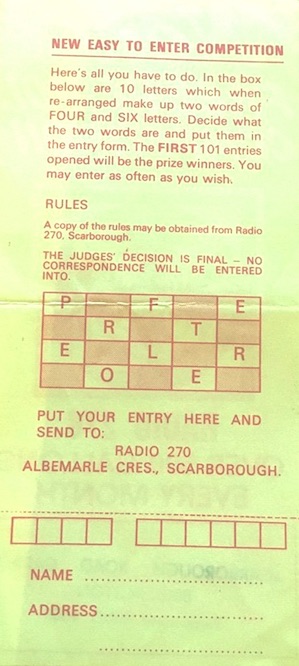
Garages bought a package for £50 for which they got 24 broadcasts of their commercial spread over a month. They received a giant poster (none seem to have survived!) and a thousand cards to give to their customers buying over 3 gallons of fuel. This card qualified the motorist to enter the competition, which was announced often on Radio 270.
Entrants had to make up six or more new words from FREE PETROL using four or more letters. The first six entrants drawn on the first Monday of each month live on the air. They won a voucher for a tank of FREE PETROL, paid for by Radio 270.
92 filling stations joined in with the promotion, which ran for six months. Some stayed 'on air' for the duration, such as Big John of Chanterlands Avenue in Hull (still going strong in 2018!)


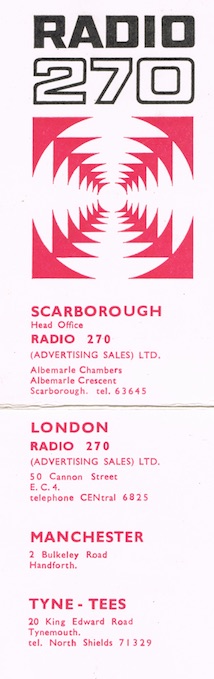
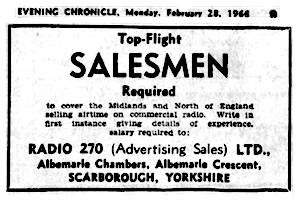
Originally, sales for Radio 270 were going to be handled by former sales staff of the Tyne Tees TV office in Newcastle, but when Wilf Proudfoot took over hehad this put ona more professional footing with national sales to be handled by a London sales office in Fleet Street, with a further office in Manchester.

DJs sell adverts
Off-duty DJs from the ship were sent out to prospective businesses to solicit advertising and over 300 advertisers came on board in 1967 before the station closed down on 14th August.
Among the best advertising salesmen from the DJ Team were Gerry Zierler, who after the closedown, set up his own TV advertising agency (still operating, very successfully) and Rusty Allen who could sweet talk almost every business he visited into buying some air time.
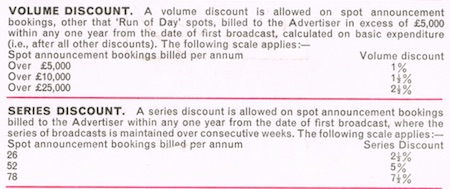
Advertising on Radio 270 was very successfull for those who indulged, as the station enjoyed very good audience figures across its area. Initially the advertising was being sold at £60 for a one minute spot, although shorter ones (as short as 7 seconds) could be had for under a fiver at off peak times. Advertisers were encouraged to book campaigns, or a series of spots rather than one-off commercials.
The station offered "live reads" where the DJ on the air would read the advertising copy from a script. Live Reads were done 'free of charge' but produced ad's incurred extra costs. These were done by Radio 270's own production department who would make up an advert, complete with background music and sound effects. These were usually made in the main "on air' studio on board the Oceaan 7, after the station had closed down for the night.
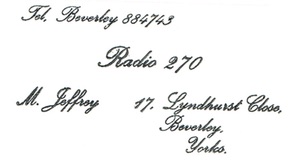
Advertising Manager Maurice Jeffrey was well-known for making up his own rates in a bid to 'close the sale' and get customers to advertise. He would negotiate with small business owners and strike a deal - here is the Order Form for a campiagn from Bolder's Record Bar in Hull (owned by the father of Trevor Bolder, who was bass for the Spiders from Mars and Uriah Heap).
The order shows a short campaign of night time adverts for £18, or £1.50 a spot! We have dozens of these old Order Forms for adverts, many from well-known companies, large and small.
Proudfoot's Supermarkets were one of the biggest advertisers on Radio 270, as their MD, Wilf Proudfoot, was an investor in the station and its MD too. Wilf did pay for his adverts, with payment being taken 'in contra' for many other services rendered to the station (e.g. rent, comestibles, fuel bills, etc).
While the records we have are incomplete (there were many deals done "off the books") we know of 653 advertisers who bought time on the station. Of the 22 advertisers who bought time in June 1966, nine were still advertising when Radio 270 was forced to close, showing that there was some 'satisfaction' at the returns being generated for advertisers.
Offshore radio
advertising worked!

Radio 270
Key Rings
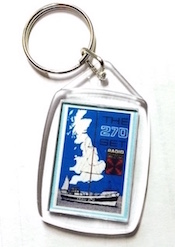

Very Special
Limited Edition
Hand-crafted by
Radio 270 engineer
Stephen Muirfield
in Guernsey, Channel Islands
(where the Oceaan 7 was fitted with
transmitters and her first mast)
Each complete with
Certificate of Authenticity
only £5.95 Incl P & P
1 side shows the
Radio 270 Set brochure,
coverage map, 270 sticker
and a shot of the Oceaan 7
Reverse side has
the Radio 270 logo
& shows many DJ's up the foremast!
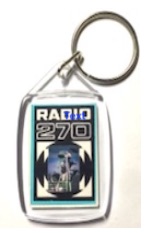
Sealed in quality acrylic with a
stainless steel key ring
Click on the
key ring
to order.

Excellent book describing
over 130 formats for radio stations,
available now on Amazon.
For more details click book cover
Radio 270 advertising
- a success?