Great new book
for Disc Jockeys

Radio 270 engineer Stephen Murifield's memories of building the station on the radio ship Oceaan 7
by Stephen Muirfeld

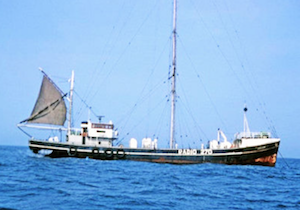
Stephen's Memories
of building Radio 270
The RCA BT10J transmitter was supplied in kit form, described on the official documents as a ‘high frequency industrial process heater’. This avoided problems with the UK customs officers from applying duty or rejecting it, so long as it was in kit form, i.e. the basic components.
We had to then re-assemble everything which we did in the Marine & General workshops in at St Sampsons harbour in Guernsey – one of the Channel Islands and out of the jurisdiction of the UK Customs. The import duty levied by the UK at that time was something like 65% of the basic cost and the transmitter could have been impounded if identified as a radio broadcast transmitter.
This book forms the perfect introduction and contains enough advice and advanced instruction to be valuable to more experienced DJs. It's informative and easy to understand for all levels and provides lots of tips and ideas to make it in what is now a very competitive world. But one that can bring untold riches, fame and fortune if you get it right!
The book is written in an entertaining no-bullshit style, with a healthy dose of realism. It includes everything you will ever need to know, from illustrated tutorials on mixing techniques and styles, digital mixing, tips on buying the right equipment and records.

For more of Stephen's memories Click HERE
Building
RADIO 270


A great new book for 2020
to help radio fans understand the myriad of radio formatics in the UK and the USA.
This book describes over 130 formats used on radio stations on both sides of the pond. It describes the history of how radio formatics developed over the last sixty years and oulines how radio differs in the UK and US markets.
Available from Amazon
just £9.95
(incl free P&P!)
for more details
We reconstructed the transmitter in the Marine and General machine shop in St Sampsons. The work was overseen by Pat Hargreaves who was an ex Scottish TV engineer, with and me acting as his go-fer. It was a RCA Ampliphase transmitter, 10KW Power of the latest design, that had the advantage of using a low level stage of Phase Modulation in the exciter. It was a system that was very effective and very economical to run because of a lot lower power consumption.
The absence of a large modulation transformer meant we were able to take full advantage of the wide frequency response and low distortion that this system provided. We could tightly control the audio response, cutting the bass response like a knife at 65cps to remove the engine rumble or low frequency noises. The hi frequency response was also tightly controlled to avoid any splatter into adjacent broadcast channels. Performance proofs of the transmitted audio were maintained, to meet FCC or EBU standards whichever was the most stringent. We strived to meet technical standards and good practices whereever it was possible.
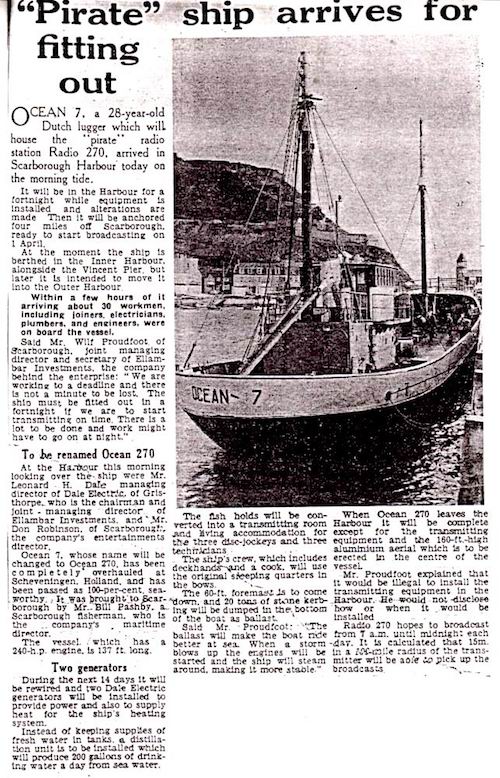
Radio 270 had a team of carpenters at work on the ship in Scarborough harbour in late February 1966 while electricians from Dale Electric installed generators.
(See newspaper cutting at the foot of this page).
To avoid problems with customs and other government departments, the Oceaan 7 ship was saield down to Guernsey in the Channel Islands for installation of the 10KW broadcast transmitter.
St Samson's harbour was the chosen spot - RCA had completed the installation of two of their 20 KW transmiitters there in late 1966, and now she was safely on station off Dunbar in Scotland. She was based on the MV Comet, an old Clyde-built lightship that was the home of Radio Scotland.
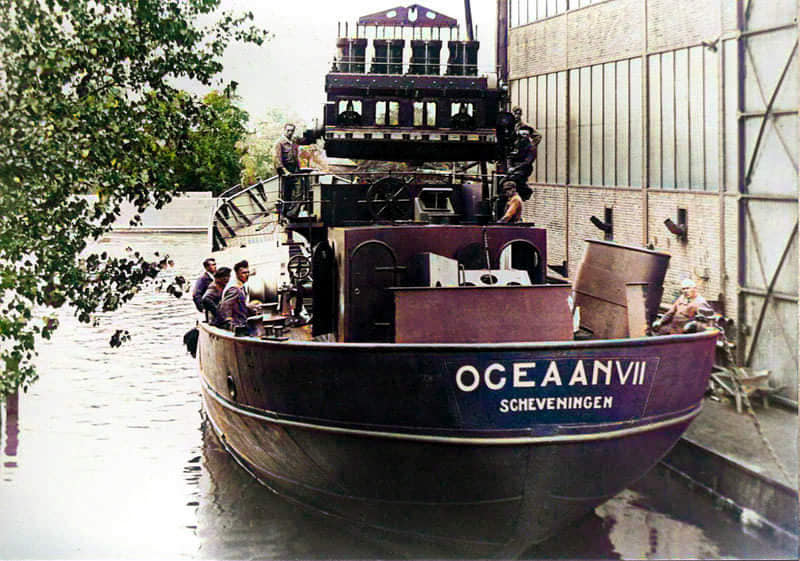
The Oceaan 7 having the reconditioned engine fitted in Holland.
Radio 270 Antenna
This may be a good time to discuss the antenna arrangements for Radio 270 aboard the Oceaan 7. The Antenna was a quarter wave folded ‘bird cage’ terminated by the sea ground. One of the problems that we needed to contend with, was as follows: with a conventional antenna of the stranded design, an insulator is used at the base of the mast.
It needs to be strong to support the weight of the mast under the stress of a moving vessel in severe storms as although the mast is quite light, there are many tons of compression and other stress at the base, where it is mounted on the ship. We knew of the other ship's had had problems with their deck insulators failing - not very funny at sea, so this problem needed to be designed out. It was designed out so far, that there simply wasn't one, making the structure much stronger. In theory at least!
Our transmission engineers, Pat Hargreaves and Peter Duncan, consulted a retired BBC special project engineer to see what could be done about a better aerial. They had first met when Pat was building and setting up the Comet for Radio Scotland.
The design he came up with completely removed the need for a deck insulator at the base of the mast and had good bandwidth, enabling better fidelity and a controlled impedance over the antenna's length. This antenna was to be fed from the deck tuning house by way of a wire in the form of a long sausage or bird cage design. It was made with high grade stainless steel cable, tensioned to stop it stretching.
This was overwound with phosphor bronze for better conductivity. It was at a horrendous cost but it is important to have a stab-ill antenna as if it stretches it will require constant re tuning; we found this out when we had to replace it after the mast failed in the storm. The cables were held apart with phosphor bronze hoops that had the same diameter as the mast this helped us achieve better control over the bandwidth.
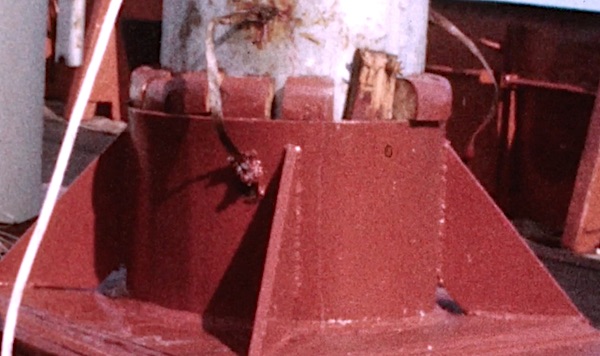
The replacement mast erected in Grimsby was loose at the base and had to be 're-inforced' by hammering sections of timber into the gaps to stop it wobbling. The cables seen are to electriclaly ground the lower mast section to the base, which had been specially fabricated from 1/2 inch steel.
Fun in Guernsey
When we stepped the mast in Guernsey, Pat Hargreaves, being of ex-naval descent, got some new Guernsey silver coins from the bank. This was so that we could uphold the traditional naval practice of putting these plus an old British penny piece and a silver crown under the mast’s deckmount. This was said to ensure good luck and safe, prosperous voyages.
The captain, the first mate, all the ship-builders and crane drivers and technical crew dispersed to a dock side pub to celebrate this tremendous event and a good time was had by all. Boy, may had sore heads the next day when the crew had to start using the big noisy drills and hammers on the steel deck.
RCA Transmitter
The RCA transmitter was very compact which was most useful as the Oceaan 7 was one of the smallest ships used for offshore radio; about the size of the tenders used by Radio Caroline and BIG L. All the available space for the studio and transmitter was very restricted and small – perfectly formed but quite compact.
The fuel consumption of the generator to power the RCA transmitter was easily adjustable compared with the others and we only used about 1.5 barrels of diesel a day to operate the station. To give some idea of the mechanical size of our RCA transmitter transmitter it was approximately seven and a half feet tall and five feet in width and all contained in one large metal cabinet .
The Continental Electronics transmitters that Radio Caroline used had high-level modulation which had some larger components and required almost as much power to modulate the carrier. Using old technology was power hungry and used big heavy iron-cored transformers. They had several big and heavy equipment cabinets. Their heavy fuel consumption meant they were expensive to run as well as to buy, and the traditional Yorkshire businesses man, who like to keep an eye on the brass at all times, thought that was the best way to go.

Radio 270's RCA BT10J transmitter
Building the studios
The studio was constructed in the old fish hold because it was preferrable to be close to the transmitter. It needed a Faraday screen constructing around the studio, a metal enclosure to prevent the radio signal getting back into the studio equipment. The fish hold was lined with wood on 3 x2” but that proced to be a double-edged sword.
We were able to make port so long as we had left for over the twenty four hours, by an old maritime convention that any vessel, whatever its flag, can enter port for repairs and provisions but must put back to sea within 24hrs, without fear of arrest or being impounded. If a ship doesn’t leave it may become subject to the host country's laws, rather than the laws of its flag nation.
In the case of the Oceaan 7, this was the central American country of the Honduras. We came into port to take on water and fuel and were able to put this to our advantage. It was therefore in the company's interest to maintain the vessel to the highest standards. Battens and a screen of fine brass mesh was applied to the studio surfaced and it was all carefully soldered together. This completely shielded the studio from the radio signals produced by the transmitter next door.
Several layers of ‘mineral walling’ were applied between the battens to fill the void and a further increase the sound isolation. A further layer of brass mesh was applied and on this surface we fixed acoustic tiles to complete the brass sandwich after which it was all connected to the technical earth and the keel for the ship’s ground.
The entry doors all needed attention and careful grounding. This required that both doors had a ground connexion where they closed, to keep the radio signal out of the studio. It was good practise to only open one door at a time to keep the radio signals out of the studio booth.
With the mast, the antenna and our transmitter install almost completed, we left St Sampson's “under tow”. This was for insurance reasons; we were towed by Bill Pashby's cobble, a traditional Yorkshire fishing boat. The weather was starting to get very rough as we passed through the Alderney race, a very volatile bit of sea.
By this time, we were starting to realise what ‘rock and roll’ radio was all about, with the 150 ft antenna acting like a pendulum. With our beam of only 32 feet, we were certainly riding the waves; the chugging of our diesel engine was very comforting on the trip in such stormy weather.
I can confirm that I fed my breakfast to the fish, after only partial digestion!
My adventure had started on the watery wireless!
Rags in the pipework to stop leaks
There was a problem with the water intake to the water distillation plant that was supposed to provide us with fresh water, but cleaning water taken from the sea. There was a problem in the engine room and a bit of a flood while the leak was attended to when the pipe work failed on the water distillation plant.
I remember that we had two days off air after the severe storm Force 11, when the damaged water intake was replaced. If there was any need for maintenance it was duly acted upon with most haste. We had ample stocks of water in the ship’s tanks, as well as canvas and timber for emergency repairs and some water-curing, quick-set concrete, of the type used for dam repairs in Holland. The vessel was 100% seaworthy and the crew very coscientious about the day-to-day maintenance. Our marine superintendant, Bill Pashby, paid very close attention to the running of the vessel, as was the Dutch captain and first mate.
The Oceaan 7's plates wear all up to the required specification, as the vessel had to pass Lloyd's certifications for us to be at sea. The certification required all plates below the water line to be tested for thickness - it was possible for the government to impound the vessel if she was unseaworthy. It’s easy for authorities to delay any repairs as happened when we later put into Grimsby for repairs. They were very picky and tried every trick to refuse our seaworthiness papers and prevent us leaving port.
Other stations of the day had been at sea for several years and were unable to maintain their vessels to such standards; their ships hadn’t seen a shipyard in years. We however were able to make port for supplies and emergency repairs, so long as we departed within 24 hours.
As we came into port to take on water and fuel it enabled us to put this to our advantage so it was in the company's interest to maintain the vessel to the highest maritime standards.

for more of Stephen's memories of the launch
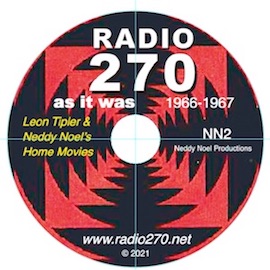
LEON TIPLER and NEDDY NOEL shot lots of home movie footage on Radio 270. Now re-engineered by Noel and available as a DVD to play whenever you wish.
See the Radio 270 men frolicking on the Oceaan7 in a Force 11 storm and other aspects of life on a real radio ship
Details on the MEMORIES page
Transmitter in bits!
The RCA BT10J transmitter was supplied in kit form, described on the official documents as a ‘high frequency industrial process heater’. This avoided problems with the UK customs officers from applying duty or rejecting it, so long as it was in kit form, i.e. the basic components.
We had to then re-assemble everything which we did in the Marine & General workshops in at St Sampsons harbour in Guernsey – one of the Channel Islands and out of the jurisdiction of the UK Customs. The import duty levied by the UK at that time was something like 65% of the basic cost and the transmitter could have been impounded if identified as a radio broadcast transmitter.
Radio 270 engineer Stephen Murifield's memories of building the station
Building the studios
The studio was constructed in the old fish hold because it was preferrable to be close to the transmitter. It needed a Faraday screen constructing around the studio, a metal enclosure to prevent the radio signal getting back into the studio equipment. The fish hold was lined with wood on 3 x2” but that proced to be a double-edged sword.
We were able to make port so long as we had left for over the twenty four hours, by an old maritime convention that any vessel, whatever its flag, can enter port for repairs and provisions but must put back to sea within 24hrs, without fear of arrest or being impounded. If a ship doesn’t leave it may become subject to the host country's laws, rather than the laws of its flag nation.
In the case of the Oceaan 7, this was the central American country of the Honduras. We came into port to take on water and fuel and were able to put this to our advantage. It was therefore in the company's interest to maintain the vessel to the highest standards. Battens and a screen of fine brass mesh was applied to the studio surfaced and it was all carefully soldered together. This completely shielded the studio from the radio signals produced by the transmitter next door.
Several layers of ‘mineral walling’ were applied between the battens to fill the void and a further increase the sound isolation. A further layer of brass mesh was applied and on this surface we fixed acoustic tiles to complete the brass sandwich after which it was all connected to the technical earth and the keel for the ship’s ground.
The entry doors all needed attention and careful grounding. This required that both doors had a ground connexion where they closed, to keep the radio signal out of the studio. It was good practise to only open one door at a time to keep the radio signals out of the studio booth.
With the mast, the antenna and our transmitter install almost completed, we left St Sampson's “under tow”. This was for insurance reasons; we were towed by Bill Pashby's cobble, a traditional Yorkshire fishing boat. The weather was starting to get very rough as we passed through the Alderney race, a very volatile bit of sea.
By this time, we were starting to realise what ‘rock and roll’ radio was all about, with the 150 ft antenna acting like a pendulum. With our beam of only 32 feet, we were certainly riding the waves; the chugging of our diesel engine was very comforting on the trip in such stormy weather.
I can confirm that I fed my breakfast to the fish, after only partial digestion!
My adventure had started on the watery wireless!
Rags in the pipework
to stop leaks !
There was a problem with the water intake to the water distillation plant that was supposed to provide us with fresh water, but cleaning water taken from the sea. There was a problem in the engine room and a bit of a flood while the leak was attended to when the pipe work failed on the water distillation plant.
I remember that we had two days off air after the severe storm Force 11, when the damaged water intake was replaced. If there was any need for maintenance it was duly acted upon with most haste. We had ample stocks of water in the ship’s tanks, as well as canvas and timber for emergency repairs and some water-curing, quick-set concrete, of the type used for dam repairs in Holland. The vessel was 100% seaworthy and the crew very coscientious about the day-to-day maintenance. Our marine superintendant, Bill Pashby, paid very close attention to the running of the vessel, as was the Dutch captain and first mate.
The Oceaan 7's plates wear all up to the required specification, as the vessel had to pass Lloyd's certifications for us to be at sea. The certification required all plates below the water line to be tested for thickness - it was possible for the government to impound the vessel if she was unseaworthy. It’s easy for authorities to delay any repairs as happened when we later put into Grimsby for repairs. They were very picky and tried every trick to refuse our seaworthiness papers and prevent us leaving port.
Other stations of the day had been at sea for several years and were unable to maintain their vessels to such standards; their ships hadn’t seen a shipyard in years. We however were able to make port for supplies and emergency repairs, so long as we departed within 24 hours.
As we came into port to take on water and fuel it enabled us to put this to our advantage so it was in the company's interest to maintain the vessel to the highest standards
RCA Transmitter
The RCA transmitter was very compact witch was most useful; the Oceaan 7 was one of the smallest ships used for offshore radio; about the size of the tenders used by Radio Caroline and BIG L. All the available space for the studio and transmitter was very restricted and small – perfectly formed but quite compact.
The fuel consumption of the generator to power the RCA transmitter was easily adjustable compared with the others and we only used about 1.5 barrels of diesel a day to operate the station. To give some idea of the mechanical size of our RCA transmitter transmitter it was approximately seven and a half feet tall and five feet in width and all contained in one large metal cabinet .
The Continental Electronics transmitters that Radio Caroline used had high-level modulation which had some larger components and required almost as much power to modulate the carrier. Using old technology was power hungry and used big heavy iron-cored transformers. They had several big and heavy equipment cabinets. Their heavy fuel consumption meant they were expensive to run as well as to buy, and the traditional Yorkshire businesses man, who like to keep an eye on the brass at all times, thought that was the best way to go.