April Fools Day 'launch'
By April 1st 1966 she was ready to go and extensive newspaper advertising was placed and a grand launch party staged in Scaborough. Unfortunately a fierce storm at dawn that morning felled the top 100 foot of the mast and the ship was unable to broadcast. It had to be taken to Grimsby where a replacement took seven weeks for a new 90 feet section to be fitted, making the mast's total height just over 150 feet tall, or 154 feet from sea level.
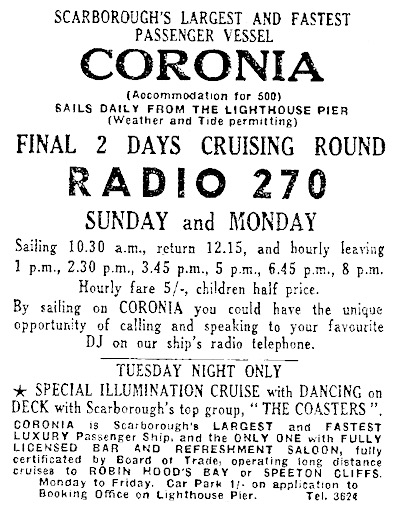
The aerial was a cage of wires, often called a sausage, running up the side of the mast, and joining it at the top, the grounded mast forming the second leg of a folded unipole. Eventually the station returned to Scarborough on the 4th June and after a week nof test transmissions, began programmes on the 11th.
Trouble on the Thames
A few weeks after 270 started, an incident on Radio City in the Thames Estuary led to its owner Reg Calvert being shot dead by a rival operator. . The government presented its bill to outlaw offshore radio just one week later in Parliament, although it was to take 14 months to become law. Everything happened in June 1966!
Bad sea conditions in the Autumn forced the ship's captains to take shelter in Bridlington Bay where Flamborough Head provided some shelter from the northerly gales. Some DJs were unable to face life on the small ship and at one stage three of them quit.
The ship however was quite safe, had two lifeboats and many lifebouys, the latest Nimbus communications and navigational equipment. It was also fully certified and she was in class, and insured, something that most other offshore stations scrimped on.
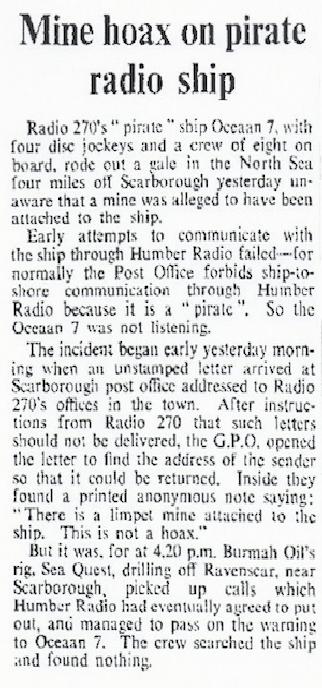
In October 1966 a bomb hoax was received, by post with no stampo. All unstamped mail was refused by 270 so the Post Office received the letter and handed it to the police. Contact was made with the ship but a full search found nothing.

The Fight for Free Radio
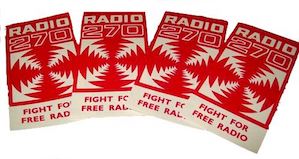
Radio 270 focussed on fighting the legislation for the next year, supporting many campaigns against the Marine Offences Act, urging listeners to write to their MPs. Among the listneres organisations Radio 270 supported were the Free Radio Campaign, the Broadside Free Radio Movement, the Local Radio Association and the Hull based Commercial Radio Supporters Club. See CRSC page for more details of the Fight for Free Radio.
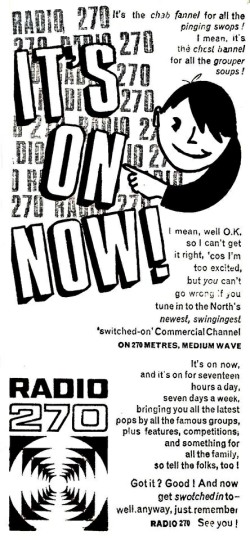
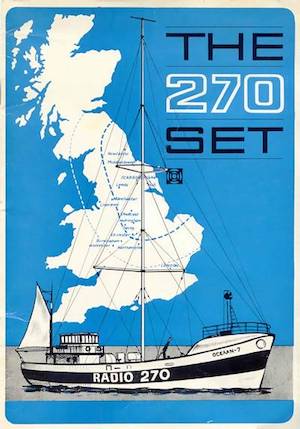
Radio 270 was an immediate hit with listeners not just in Yorkshire but as far south as the East Midlands, and all the way up north past Newcastle. In the early days, the station advertisied a lot of direct sales products, including electric blankets, DIY tools, ladies stockings and even photographs of the DJs. Joining the listeners club, the Radio 270 Set qualified listeners for generous discounts on these offers, priority requests and a glossy booklet about the radio station and staff.
RADIO 270 was the brainchild of Scarborough businessman DON ROBINSON, who had businesses all over the UK in tourism, TV and sport promotions. He travelled to Harwich to study the Radio Caroline operation just as Caroline South were considering of expanding to reach the north east.
Don almost bought the RADIO SYD ship at one stage; the contracts were drawn up but never signed. Don was later involved in an aborted relaunch of Radio 390 North from the Cheeta II. The other two founders were BILL PASHBY a well known Scarborough fisherman and ROLAND HILL who farmed just outside the Scarborough.
Don brought WILF PROUDFOOT in to lend some credibility to the project, as well as some financial investment. "I was looking for ways to advertise my new stores, and heard about this new Radio Yorkshire. I called their office and asked how much to advertise, and Don contacted me almost immediately and asked me to join them as MD." explains Wilf.
Don also recruited LEONARD DALE who became a major shareholder in the project and Chairman.
OCEAAN 7
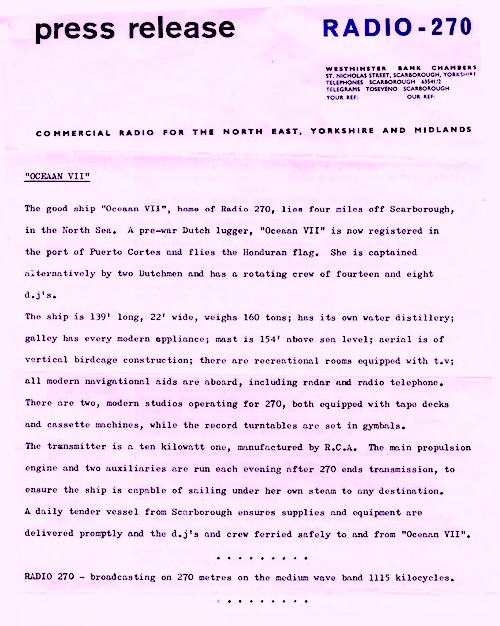
The ship was a former Dutch fishing boat, the Oceaan 7 which was quickly converted to a floating radio station. She was going to be named OCEAN 270, but paperwork and bureacracy meant she kept her Dutch name, OCEAAN 7.
She was fitted with a single presentation studio, a newsroom and announce booth, a transmitter room and a 161 feet tall antenna mast. This was in two sections - the lower 61 feet was a former test mast from a racing yacht, the Norsaga. The top 100 feet was a new section of Sparlight aluminium.
Generators and all the electrics were fitted by Dale Electric of Filey and large water and diesel tanks were fitted to the ship, partly in Scarborough and then in Guernsey where the transmitter provider (RCA) had a 'tax free' harbour facility. The studio was designed by PETER DUNCAN and built by local firm TUNSTALL BYERS.
The Oceaan VII also had a complete overhaul. Some huge water and fuel tanks were fitted as well as a water distillation plant and the latest navigation and communications equipment installed on board.

Oceaan VII
the closedown.
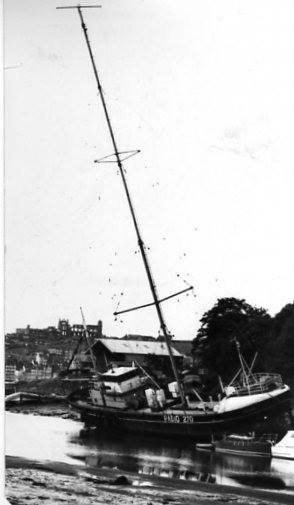
After the closedown at midnight on Monday August 14th, the Oceaan 7 sailed into Bridlington and berthed just after 1 am where over a thousand fans were thronging the piers to welkcome the DJs. The ship sailed the next day for Whitby where she remained tied up next to a ship yard for 18 months while local estate agents Tuckleys tried to sell her for £12,500. the price included quite stock of records and the studio equipment and transmitter.
Radio Caroline tried to buy the Oceaan 7 after their two ships were hijacked in March 1968, but they didn't come up with the cash. Four Radio Caroline DJs and the owner of the station, Ronan O'Rahilly, spent a week at the Hayburn Wyke Hotel near Cloughton trying to get the funds together and browbeat the Radio 270 directors to let them have the ship for nothing. They bought hundreds of records from Headlams in Whitby and tried to recruit some local seamen.
Like most Yorkshiremen, the Radio 270 board were not going to be 'had'! Eventually someone told a journalist about the ship being 'made ready' to replace Caroline, and the story was splashed too early; the game was suddenly "off".
The mast was finally removed from the ship in September and at 8am on Sunday 27th October the Oceaan 7 was taken first to Hartlepool and then on to Blyth in Northumberland where local scrapyard T. Smiths broke her up.
The following year the IBC (International Broadcasting Society) bought the Radio 270 equipment, which they then used to establish Capital Radio in 1970, off the Dutch coast. The transmitter was later bought by Radio Atlantis, a Belgian station, and they used it in 1974.
A very sad end to a little ship that brought such pleasure to millions of pairs of ears.
Oceaan VII
the closedown.
After the closedown at midnight on Monday August 14th, the Oceaan 7 sailed to Bridlington and, just after 1 am over a thousand fans were thronging the piers to welcome the DJs.
The ship sailed the next day for Whitby where she remained tied up next to a ship yard for 18 months while local estate agents Tuckleys tried to sell her for £12,500. The price included quite stock of records and the studio equipment and transmitter. Many of the records were later sold via Proudfoots Supermarkets.
Radio Caroline tried to buy her after their two ships were hijacked in March 1968, but they didn't come up with the cash. Four Radio Caroline DJs and the owner of the station, Ronan O'Rahilly, spent a week at the Hayburn Wyke Hotel near Cloughton trying to get the funds together and browbeat the Radio 270 directors to let them have the ship for nothing. They bought hundreds of records from Headlams in Whitby and tried to recruit some local seamen.
Like most Yorkshiremen, the Radio 270 board were not going to be 'had'! Eventually someone told a journalist about the ship being 'made ready' to replace Caroline, and the story was splashed too early; the game was suddenly "off".
The mast was finally removed from the ship in September and at 8am on Sunday 27th October the Oceaan 7 was taken first to Hartlepool and then on to Blyth in Northumberland where local scrapyard T. Smiths dismantled her.
The following year the IBC (International Broadcasting Society) bought the Radio 270 equipment, which they then used to establish Capital Radio in 1970, off the Dutch coast. The transmitter was later bought by Radio Atlantis, a Belgian station, who they used it in 1974.
A sad end to a ship that pleased millions of pairs of ears.
Death of Radio 270
The last day of transmissions was to be Monday August 14th, 1967. It dawned appropriately overcast, glloomy and raining with a NE 6 blowing and heavy seas running. The station's regular tender, the Monica 2 from Bridlington, was unable to put to sea and would not have got alongside anyway, and it was too rough for the radio ship to risk putting into Bridlington harbour to pick up the holidaying DJs.
Left on shore kicking their heels were: Mike Hayes, Paul Kramer and Mike Barron, leaving just a skeleton crew of Rusty Allen, Ross Randell and Phil Hayton (a newsreader) to make the last few day's broadcasts.
Mike Hayes was a very resourceful former RAF man and he persuaded the crew of the Air Sea Rescue Helicopter at 202 Squadron at RAF Leconfield in East Yorkshire to make a mercy misson out to the ship to drop final programme excerpts to the radio ship, wallowing in heavy seas in Bridlington Bay. Contained in the bag with the tapes was an important instruction: "Do not mention the chopper or RAF LEconfield" but as the bag fell in the sea and the note wasn't seen.
The DJs on the ship thanked the boys from RAF Leconfield several times for attempting to make the drop, which resulted in a demand by the Prime Minister, Harold Wilson, into why the RAF had tried to help Radio 270.
MIKE HAYES explains:
"I couldn't get back on board that day as the ship had moved because of bad weather so I rang the nearby Royal Air Force Air Sea rescue base at Leconfield near Beverley and asked if they'd drop a package to Radio 270 for me. :(For those who are unaware of it, I'm ex RAF as is Paul Burnett.)
"No problem," they said so I recorded a farewell message to our listeners and that was packed in a box, inside another box, inside another box, etc., and rushed it down to the RAF station.
"The drop failed and just missed the boat, so Rusty and Alan never saw the package and the message to not mention the RAF," said Mike.
I'd promised the lads I'd be down to buy them all a pint afterwards but then people like Harold Wilson got involved and there was a bit of a problem. I rang them, thanked them and apologised for the kerfuffle.
When the package missed the ship the lads obviously didn't see the message written an all 6 sides of the box in large black letters, "DO NOT MENTION THE ROYAL AIR FORCE!!!!!!!!".
A footnote: I sent Mr Wilson a telegram, he was on holiday in the Scily Isles, explaining that it was my fault and asking him not to lean too heavily on the flying lads. A reply there came not!
Mikimo

Yorkshire Coast
radio adventure
Radio 270
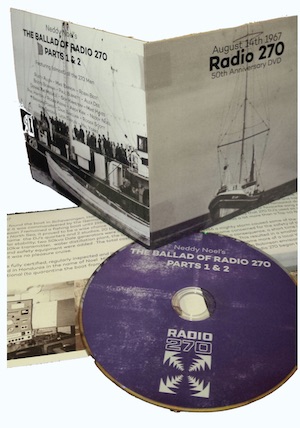
Souvenir DVD
Neddy Noel's home movie
shot on board Oceaan 7
with the voices of the 270 men

for full details
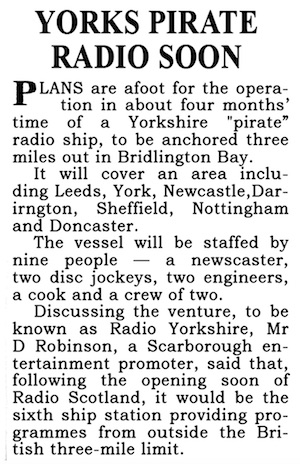
The first press reports of the station appeared in the regional press during October 1965. The founder of the station was Scarborough entrepreneur, Don Robinson. A well known promoter of pop concerts at the Bridlington Spa - he brought the Rolling Stones and Ike & Tina Turner to the resort.
Don had met with Radio Caroline 's Ronan O'Rahilly and been romanced by Ronan's stories of huge wealth. Don decided to start a radio station for the North East, to be called RADIO YORKSHIRE.

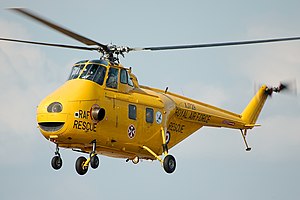
RAF 202 Squadron Whirlwind in flight

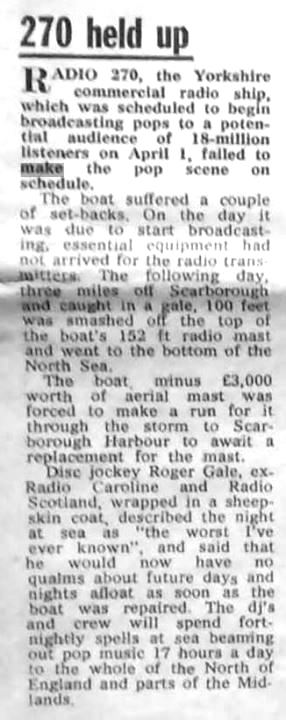

Radio 270
Oceaan 7 in Whitby tied up on the eastern bank of the River Eske